Russia's Crypto Crackdown: BTC and ETH Win Either Way
Moscow's new law is designed to trap savings in rubles, but history says capital always finds a way out
Ticker Ratings
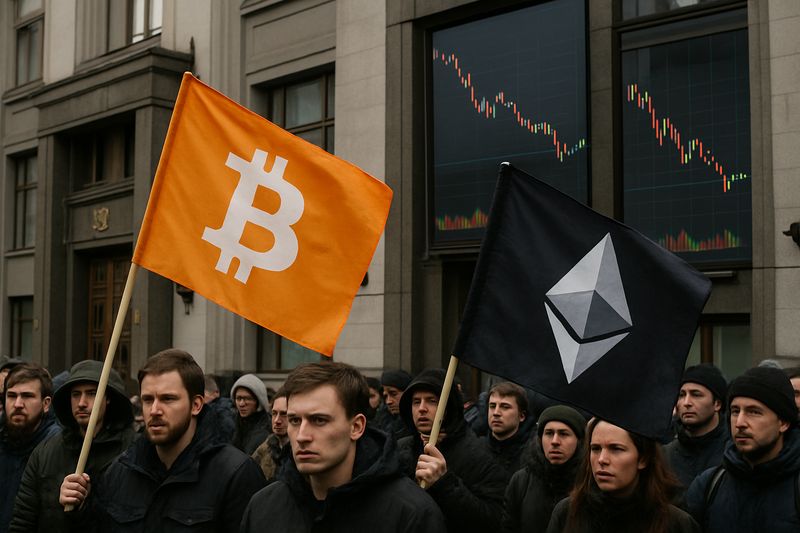
Russia just passed what some are calling its own version of a crypto clarity act, and on the surface it sounds bearish: ordinary citizens are now capped at buying 300,000 rubles (roughly $3,700) worth of crypto per year. Call it the world's most restrictive crypto HODLing plan, courtesy of the Kremlin.
But here's the thing nobody in the Duma apparently considered: when a government explicitly tells you that crypto is dangerous enough to require capital controls, they're accidentally writing the most compelling $BTC and $ETH marketing copy imaginable. As Andrei Jikh breaks down in his latest YouTube deep dive, the law isn't about embracing crypto. It's about keeping ruble savings inside Russia's financial system and preventing capital flight. Translation: the Russian state is terrified of what happens when citizens can freely exit into decentralized assets.
This lands in a macro environment that's already electrically charged for crypto. The Hormuz crisis has oil sitting at multi-year highs, the 30-year Treasury recently touched 5.216%, and traditional safe havens are looking anything but safe. Bitcoin and Ethereum quietly ripped earlier this week as the Hormuz crisis sparked a genuine safe-haven crypto bid, a trend we covered here at BullApe. That bid hasn't gone away.
The Russia angle adds a new layer. Every time a major government clamps down on crypto access, it validates the asset class as a legitimate threat to fiat sovereignty. We saw it with China's mining ban in 2021. We saw it with India's on-again off-again tax regime. Each crackdown was followed, eventually, by a surge in underground demand and global price appreciation. Russia's 300,000-ruble ceiling isn't a death knell for crypto adoption. It's a neon sign that reads: this stuff works.
The bear case is real, though. If other major economies follow Russia's playbook and begin restricting crypto purchases under the guise of financial stability, institutional on-ramps could face new friction globally. Regulatory contagion is always a tail risk worth pricing in, especially when geopolitical tensions are already making markets jumpy.
Still, watch the on-chain data over the next 30 days. If Russian wallet activity migrates to peer-to-peer markets and non-KYC exchanges, the narrative flips from crackdown to black market premium, and that has historically been rocket fuel. Governments keep trying to put the genie back in the bottle. The genie keeps getting bigger.
BullApe's AI grades every pick against the S&P 500 - wins and misses published. See the track record →