Ross Stores $ROST Jumps 7.5% as Off-Price Retail Wins the Tariff Era
While Wall Street obsessed over Bitcoin and bond yields, two boring retailers quietly crushed earnings and raised guidance
Ticker Ratings
Everyone spent the week doom-scrolling Treasury yields and Bitcoin charts. Meanwhile, $ROST and $BJ quietly reminded the market that when consumers are stressed, they shop smarter, not less.
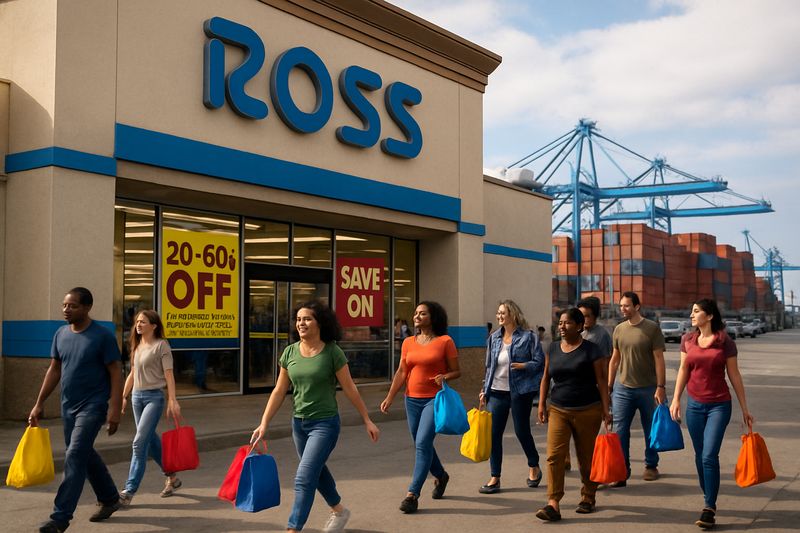
Ross Stores popped 7.5% in premarket after reporting a strong Q2, raising its full-year EPS forecast, and announcing plans to open roughly 115 new stores this year, more than originally expected. Comp store sales growth was driven by both new and returning customers, which is exactly what you want to see: the brand isn't just holding its base, it's pulling people in from full-price competitors. And here's the kicker: Ross is actually catching a tailwind from tariffs, as tariff refunds are padding margins at a moment when most retailers are sweating import costs. The stock has delivered a 10-year annualized return that has quietly outperformed most of the flashier names people obsess over on fintech Twitter.
BJ's Wholesale Club was no slouch either, jumping 5.6% after beating street expectations on comparable sales. The warehouse club format continues to attract budget-conscious households, and with ground beef now running above $7 per pound and mortgage payments consuming 34% of a typical family's income, the value proposition for membership clubs has rarely been stronger. People are not going to stop eating. They're just going to stop paying Whole Foods prices to do it.
The broader context here matters. Cramer's Mad Money episode this week dedicated an entire segment to the difference between cyclical and secular stocks, and both Ross and BJ's fit squarely into the secular bucket: they grow consistently regardless of the business cycle because they serve a need that doesn't disappear when the economy wobbles. Meanwhile, $TJX (already covered, but worth noting in this company) raised its full-year adjusted EPS guidance to a range of $5.15 to $5.20, adding further confirmation that the off-price category is in a structural growth phase, not just a recession trade.
The bear case is straightforward: if the economy reaccelerates and consumers feel flush again, they drift back to full-price retail. But with 30-year yields at 5.2%, housing affordability at multi-year lows, and food inflation still biting, that scenario feels about as likely as the Fed cutting rates next Tuesday.
The trade-down trade has a pulse, a raised guidance range, and 115 new store openings. That's not a rumor, that's a business plan.