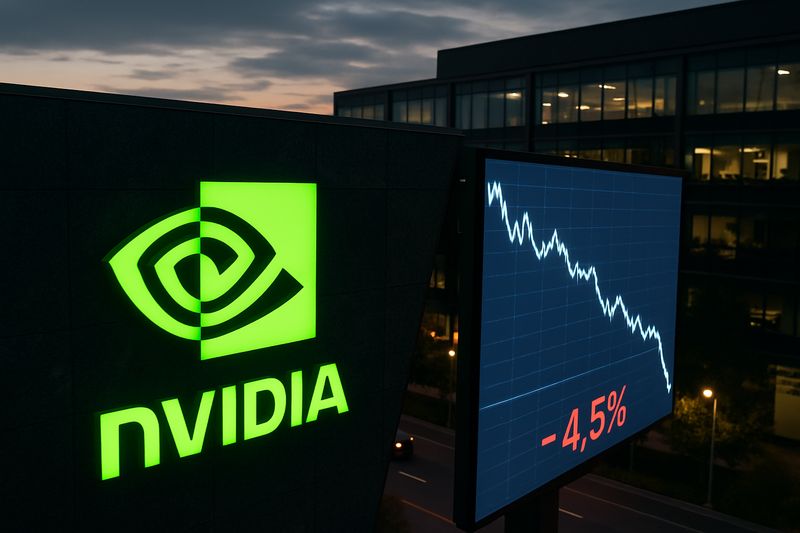
Nvidia $NVDA Falls 4.5% But Tom Lee Says the Math Still Works
Chip stocks got hit hard after Warsh's Jackson Hole speech, but the bull case for Nvidia isn't as broken as Friday's close suggests
Ticker Ratings
$NVDA dropped 4.5% on Friday and took half the semiconductor sector down with it. The Philadelphia Semiconductor Index fell more than 3%, with $MRVL leading the carnage. Meanwhile, Fed Chair Kevin Warsh was at Jackson Hole telling everyone that inflation is still running hot at 3.7% PCE on a 12-month basis (above 4% on the 6-month measure), and the probability of a September rate hike jumped from roughly 35% to 56% by end of day. It was, in short, a brutal Friday to be long anything with a high multiple.
But here is where it gets interesting. Fundstrat's Tom Lee pushed back hard in a YouTube segment, arguing that Nvidia's valuation multiple is actually contracting even as earnings estimates get revised sharply higher. That is the opposite of the bubble narrative. His read: investors who were underweight $NVDA going into earnings are now selling names like $AMD, $META, $AMZN, $GOOGL, and $MRVL to fund the rotation in. So the broad tech selloff is less about panic and more about portfolio shuffling by people playing catch-up.
The $MRVL situation is a perfect case study in how cruel elevated expectations can be. Marvell reported 37% revenue growth and data center revenue topping $2 billion (up 46% year-over-year), then guided Q3 to $3.15 billion above consensus, and the stock still sold off. CNBC's market open coverage noted the selloff was driven entirely by investor expectations that had simply gotten ahead of the fundamentals. Strong quarter, wrong vibe.
The macro backdrop makes all of this messier. Warsh's hawkish Jackson Hole debut sent the 2-year Treasury to 4.34% and the 10-year to 4.72%. Higher rates compress growth multiples, and chip stocks live and die by those multiples. Dan Niles of Niles Investment Management noted on CNBC that he is positioned with more shorts than longs right now and is not fighting the Fed, which is a pretty reasonable stance when September hike odds are sitting above 50%.
Mohamed El-Erian offered the one genuinely optimistic counterpoint: markets may be overpricing the September hike, and AI's potential as a new factor of production could allow the economy to grow faster without triggering more inflation. Warsh himself nodded to AI at Jackson Hole, citing annualized token sales for leading AI labs exceeding $100 billion, up 500% in 12 months. That is a productivity story. Whether the Fed believes it fast enough to hold off in September is the $64,000 question.
Nvidia is not cheap, but it might be cheaper than you think. Marvell is having its feelings hurt by its own investor base. And the Fed just told you it is not done yet, so maybe keep some dry powder around for when the dust settles.