Jim Cramer Says AI Investors Are Missing the Aerospace Trade
YouTube's top finance voices are converging on one idea: the data center obsession is creating a blind spot in industrial and aerospace stocks
Ticker Ratings
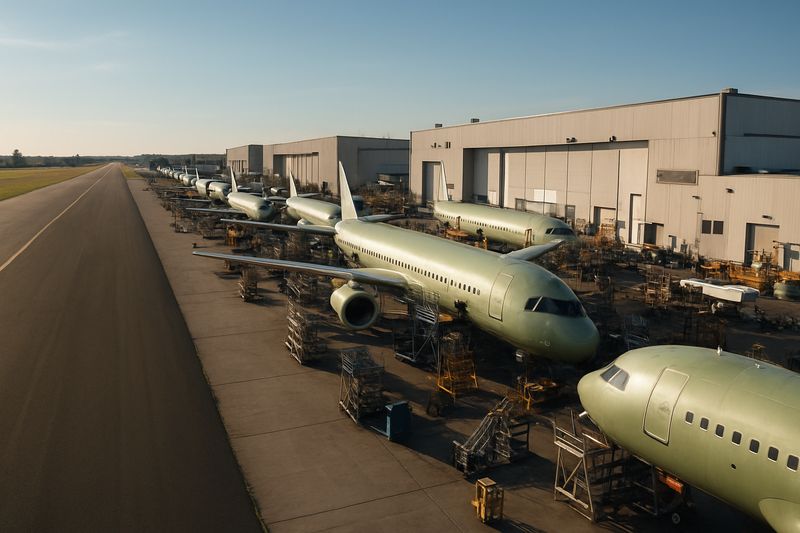
If you watched Jim Cramer on Mad Money this week and took a drink every time he said 'data center,' you'd be sober by minute three. His whole point is that Wall Street is so fixated on AI infrastructure that it keeps stepping over perfectly good industrial plays sitting right on the floor in front of it. The one he keeps circling back to: $GE Aerospace.
The catalyst is real and it's big. GE Aerospace announced a nearly $12 billion acquisition of Consolidated Precision Products, a castings manufacturer that feeds directly into commercial aircraft and defense engine supply chains. Bloomberg Intelligence pegged the deal at $11.75 billion, funded with $7 billion cash and new debt, structured to vertically integrate GE's supply chain and potentially capture more share in next-generation LEAP engines used by both Airbus and Boeing. Cramer's read: this supports higher production volumes, and the read-through for $BA Boeing is positive too, with delivery lumpiness described as a near-term noise problem rather than a structural one.
The bear case on Boeing is loud right now, the Spirit AeroSystems acquisition drama, slow delivery numbers, general 'Boeing is cursed' energy in the media. But both Cramer on CNBC and the Bloomberg Intelligence desk are essentially arguing the same thing: the problems are known, partially priced in, and the underlying demand backdrop (Asia, India, Southeast Asia, aging US fleets) is exceptionally strong. The AerCap CEO made the same point on CNBC, calling Asia the primary engine of global aircraft demand and describing the US fleet as the oldest in the world, which implies a replacement supercycle that benefits the whole aerospace food chain.
Meanwhile, the contrarian crowd is getting louder on AI. Jared Dillion on Bloomberg flagged The Economist's Jensen Huang 'magician' cover as a textbook contrary indicator, drawing parallels to the 2000 telecom buildout. Liz Harrow of Shockti VC pushed back on Bloomberg, arguing AI contributed roughly 25% of US GDP growth in 2025 and the real opportunity is at the application layer anyway, not the infrastructure bets everyone is already crowded into. Both views can be right simultaneously: the AI trade is not dead, it's just rotating, and the construction plays are giving way to consumption plays.
The rotation thesis is gaining real traction. On CNBC, one analyst highlighted the QTOP ETF (top 30 Nasdaq 100 names) as the cleaner read on AI market leadership, currently sitting roughly 4% below its highs as semiconductors recover from a summer selloff. The Qualcomm-Amazon deal this week, a multi-generational chip supply agreement with a $60 billion ceiling and Amazon receiving rights to acquire up to $4 billion in Qualcomm shares, is the clearest signal that the AI chip story is diversifying beyond Nvidia. That's not the AI trade dying. That's the AI trade growing up.
Cramer's core message and the broader YouTube consensus this week is essentially the same: the macro is messy (oil near $100, yields near 5%, CPI on Friday), but industrial America is quietly having one of its best stretches in years, and the investors who are still staring at GPU shipment data might be the last ones to notice.
BullApe's AI grades every pick against the S&P 500 - wins and misses published. See the track record →