Hybrids Now 14% of US Car Sales and a $700K Audi Proves Why
YouTube's top auto and finance creators agree: the hybrid is not a bridge technology, it is the destination
Ticker Ratings
Everyone spent a decade being told hybrids were a pit stop on the road to full electrification. Turns out the pit stop has a valet, a champagne bar, and a 987-horsepower twin-turbo V8. According to Bloomberg's auto coverage this week, hybrids now account for 14% of new US car sales, roughly double the share of pure EVs, and the trend is accelerating in exactly the direction nobody predicted: up market.
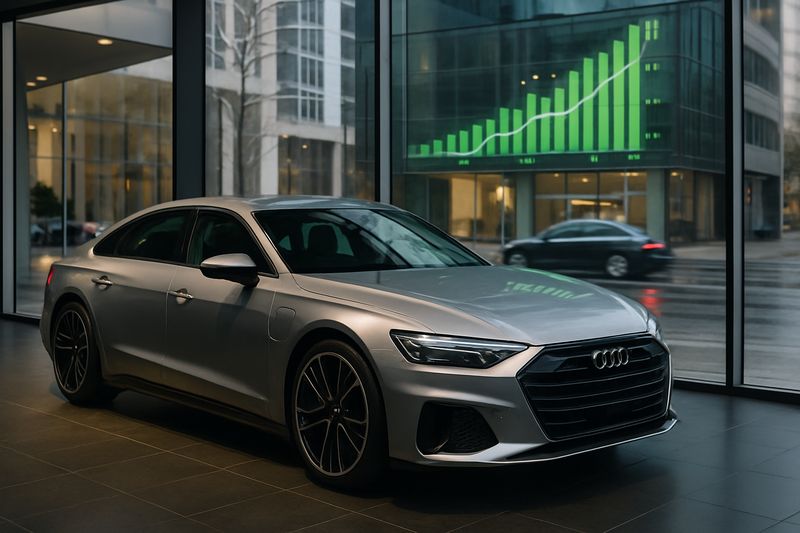
The poster child is the new Audi Neuvelari, a $700,000 hybrid supercar limited to 499 units, with deposits opening in early 2027 and deliveries targeting 2028. It shares a platform with Lamborghini, puts out 987 horsepower through a combination of a twin-turbo V8 and three electric motors, and drives, per Bloomberg's Hannah Elliott, lighter and more nimbly than its brutalist exterior suggests. Elliott's one complaint was the spartan interior not feeling worthy of the price tag, which, at $700K, is a fair grievance. But the point is not the cabin trim. The point is that premium automakers are doubling down on combustion engines, not phasing them out.
Why? Because wealthy buyers still want the sound, the vibration, and the emotion of a real engine, and they want the instant torque of an electric motor at low speeds as a bonus, not a replacement. Audi and Lamborghini are not going hybrid because they have to. They are going hybrid because it makes the performance numbers better. That is a fundamentally different story than the one the EV-only crowd has been telling.
The broader consumer trend backs this up. Allspring Global Investments, covered in Bloomberg's Jackson Hole recap, flagged global supply chain realignment as a tailwind for mid-cap industrials, and the hybrid supply chain is a direct beneficiary of that theme. Companies making power electronics, battery management systems, and hybrid drivetrains are quietly positioned at the intersection of two of the biggest capex cycles of the decade: auto electrification and onshoring.
Meanwhile, the EV narrative is having a rough summer. Between high interest rates making EV loans more painful, charging infrastructure anxiety, and resale value uncertainty, the hybrid's value proposition has never looked cleaner. You get the efficiency credits, the performance upside, and you can still fill up in four minutes at any gas station on the planet.
The $700,000 Audi is not for regular people. But it is a very loud signal about where the industry's most profitable customers are putting their money, and those customers tend to be right about what comes next.