Worst Day Since April: Fed Drama Sends Dow Down 1,153 Points
A confusing Fed press conference, geopolitical fires, and mixed mega-cap earnings created the perfect storm for the sharpest market sell-off in months
Ticker Ratings
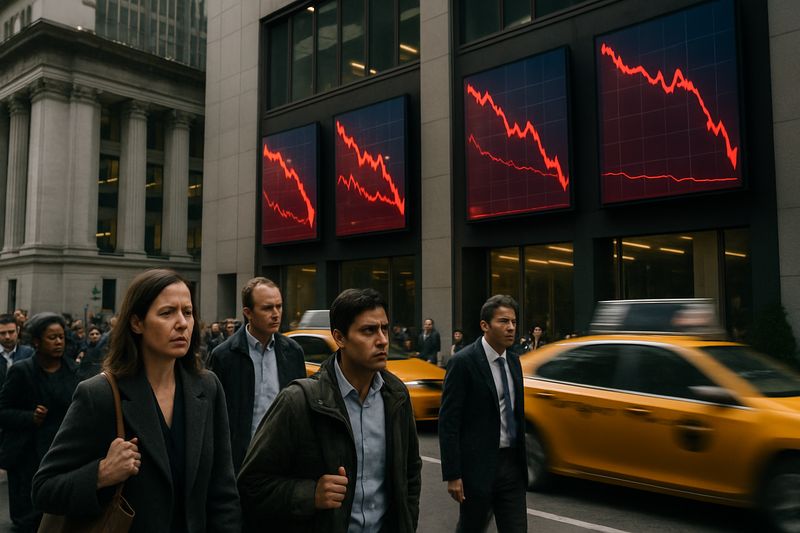
The Federal Reserve held interest rates steady at 3.75% on July 29 and managed to torch the market anyway. New Fed Chair Kevin Warsh delivered a press conference so thoroughly confusing that analysts were left asking whether the Fed has any idea what it is doing. The result: the Dow dropped 1,153 points, its worst single-day loss since April 2025, the S&P 500 shed 112 points, and the Nasdaq slid 433 points into correction territory, now down roughly 10% from its June peak.
The chaos in bonds told the real story. While 2-year yields fell about 6-7 basis points as markets priced out a near-term hike, the 30-year yield surged 11+ basis points to around 5.20-5.21%, its highest level since 2007. That bear steepening of the yield curve, which Bloomberg Intelligence called a reverse operation twist, is a flashing signal that long-term inflation expectations are unanchored and bond vigilantes are losing patience. Three regional Fed presidents, Hammock, Kashkari, and Logan, dissented in favor of a hike. The vote was 9 to 3, and the three dissenters are quickly becoming the adults in the room.
Warsh did not help himself. He cited the Lucas critique, questioned the quality of both private and public inflation data, and announced a task force to review the Fed's measurement tools. Cool in theory, terrifying in practice when inflation has run above the 2% target for more than five years and you have been on the job for eight and a half weeks. Markets were looking for a compass and got a philosophy seminar.
Layered on top of the Fed drama: geopolitical risk is back at a boil. US strikes on Iran are now in their 13th consecutive night according to Reuters, the US intercepted Iranian ballistic missiles, and physical oil prices are approaching $110 in some markets with Brent hovering near $85. Gold is catching a bid on the pause in hostilities. This is not a background risk, it is a front-page macro event that changes energy costs, shipping lanes, and corporate margins in real time.
The earnings picture added insult to injury. $MSFT was the one genuine bright spot, up roughly 3% after hours on Azure growth of 43% year-over-year and Copilot paid seats hitting 30 million, up from 20 million in March. $META fell 5-9% after hours despite 28% revenue growth because operating margins collapsed from 43% to 31%, free cash flow nearly evaporated, and the company is now carrying $2.4 billion in annual legal costs from youth safety lawsuits alongside $1.2 billion in severance. $QCOM dropped nearly 6% after hours on a weak Q3 earnings guide of $2.15 midpoint versus street expectations, even as its auto segment posted a record quarter.
The so-called broadening trade that gave bulls comfort heading into summer is now visibly cracking. When all eleven sectors drop together on a Fed hold day, you are not seeing profit-taking. You are seeing a market that has repriced the risk of a Fed that cannot communicate, an Iran war that will not end, and a tech sector where spending is accelerating faster than revenue can follow. September rate hike odds just got a lot more interesting, and not in a fun way.