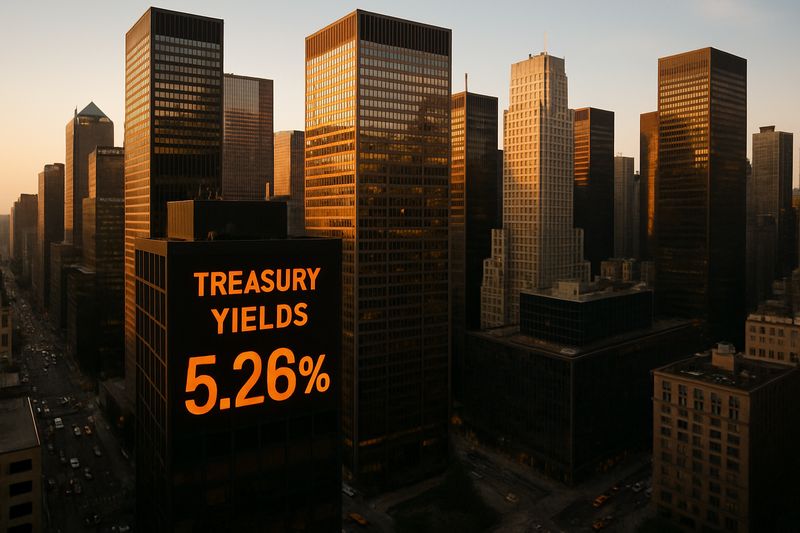
Treasury Yields Hit 5.26%: Why Cramer Is Right About P/E Rotation
Rising Treasury yields are reshuffling the deck, and YouTube's top finance voices agree on who gets hurt and who quietly wins
Ticker Ratings
| Ticker | Rating | Entry Price | Current | $ Gain | % Gain |
|---|---|---|---|---|---|
| NVDA NVIDIA CORP | buy | $225.18 | - | - | - |
| DELL Dell Technologies Inc. | buy | $487.90 | - | - | - |
| MDB MongoDB, Inc. | sell | $383.41 | - | - | - |
| AVGO Broadcom Inc. | hold | $356.20 | - | - | - |
| SNOW Snowflake Inc. | buy | $378.75 | - | - | - |
| PLTR Palantir Technologies Inc. | hold | $171.16 | - | - | - |
| CRWD CrowdStrike Holdings, Inc. | hold | $208.00 | - | - | - |
| CRDL Cardiol Therapeutics Inc. | buy | $2.19 | - | - | - |
The 30-year Treasury yield sitting at 5.26% is not a fun fact. It's a flashing neon sign that says: if your stock is priced for perfection, the market is coming for you. Bloomberg's Odd Lots brought on Stanford finance professor Darrell Duffie to explain the mechanics, and it's grimly straightforward: the US is running a $31 trillion debt load growing at $2 trillion per year, foreign central banks have essentially tapped out of buying Treasuries, and domestic discretionary investors like hedge funds and pension funds are now the marginal buyer. They want more compensation to absorb that duration. Hence, yields go up and they probably stay up.
Jim Cramer on Mad Money connected the dots for equity investors in a way that was, honestly, clearer than usual. Rising bond yields compress multiples on high-P/E stocks because higher discount rates shrink the present value of future earnings. He flagged MongoDB at 58x earnings and Palo Alto Networks at 79x as the obvious targets. Meanwhile, he highlighted $DELL at under 20x and $NVDA at 24x current earnings (just 14x next year) as relatively cheap, which tracks with Dell's 15.8% single-session surge after it raised its annual sales forecast on AI server demand. The market is not rejecting AI. It's repricing it.
Fundstrat's Tom Lee is taking the contrarian side, arguing the wall of worry in September is actually a buy signal. His logic: if JP Morgan, Wells Fargo, and Citadel Securities are all publicly cautious, too much pessimism is priced in. He's betting upcoming jobs and CPI data will soften enough to push rate hike odds toward zero. The ADP print of only 38,000 private payrolls in August versus a 47,000 estimate, with manufacturing shedding 17,000 jobs, is at least consistent with his thesis.
The bull and bear case on $NVDA illustrates the tension perfectly. Bulls point to 14x forward earnings as cheap for a company at the center of an AI infrastructure buildout that Nvidia's own CEO Jensen Huang is comparing to a new industrial revolution. Bears note that Broadcom barely moved after its own strong earnings print, even with CEO Hock Tan projecting AI chip revenue hitting $115 billion in fiscal 2027 and $230 billion the year after. When extraordinary guidance barely moves a stock, that's the yield environment taxing every multiple in the room.
The rotation trade is real, it's data-driven, and the winners are hiding in plain sight: low-P/E, cash-generative names that don't need a falling discount rate to justify themselves. The losers are anything priced like interest rates were still at zero. Spoiler: they haven't been for a while.