SpaceX-Tesla Merger Could Be History's Biggest Deal: What It Means for Markets
A potential SpaceX-Tesla tie-up, blowout AI earnings, and a bubble warning from Citadel's Ken Griffin all landed in the same week. Markets have a lot to digest.
Ticker Ratings
This week handed markets a full plate: a 160% revenue surge from SpaceX, a proposed merger that would dwarf anything in corporate history, and Citadel's Ken Griffin openly comparing the AI trade to the telecom fiber overbuild of 2000. The S&P 500 mostly shrugged, closing around 7,712 with modest gains. But under the surface, the rotation signals are loud.
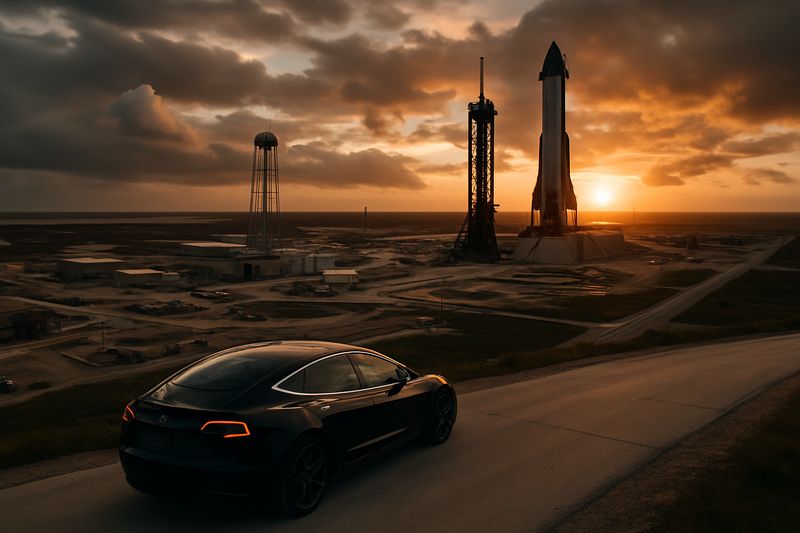
$SPCE is not the SpaceX we are talking about, but the private one printed a quarter that genuinely stunned Wall Street: revenue of $14.58 billion versus estimates of $12.87 billion, and net income of $4.4 billion, more than double the $1.8 billion consensus. Starlink hit 13.6 million subscribers, and the company's AI business grew ninefold year-over-year. Then Elon Musk proposed merging it with $TSLA in what Brad Gerstner of Altimeter Capital estimates would value Tesla shares at $400 to $550 per share. Special committees formed at both companies. Markets cheered Tesla in pre-market. Governance lawyers started sharpening their pencils.
The bull case is real: SpaceX brings scale, compute, and Starlink cash flows. Tesla brings the EV brand, a manufacturing base, and access to cheaper public capital. Gerstner noted that xAI's Elon Musk is deploying 200,000 GB300 GPUs per month and targeting 10 gigawatts of compute by end of 2026, roughly 25% of all US capacity additions. If SpaceX's data center capacity can feed that machine, the synergy argument is not crazy.
The bear case, delivered calmly and precisely by Ken Griffin on Bloomberg, is that GPU overcapacity could cause marginal pricing to collapse the same way dark fiber did after the dot-com boom. He is not calling it a fraud. He is calling it a cycle, and cycles end. $SMCI surging 12% on preliminary Q1 sales of $18.5 to $19.5 billion (versus prior guidance of $14.5 billion) feels very much like the kind of number that looks great until the demand curve shifts.
Meanwhile the macro backdrop is doing nobody any favors. The 10-year Treasury yield sits at 5.15%, mortgage rates are stuck at 7.5% through all of 2027 per Fannie Mae, and oil briefly touched $110 a barrel on Hormuz disruption fears before Trump's Russia sanctions waiver took some heat out of the market. The VIX dropped to 18.44 from a scary 19.99 on Friday, which is either markets calming down or markets not paying attention. Pick your interpretation.
The AI trade is not dead, but it just got a serious stress test: a megamerger proposal that raises governance red flags, a bubble warning from one of the smartest allocators alive, and a Treasury yield that makes every growth multiple a little harder to defend. The next few weeks will tell us whether SpaceX's blowout quarter was a rising tide for the sector or just Elon Musk doing Elon Musk things again.
BullApe's AI grades every pick against the S&P 500 - wins and misses published. See the track record →