Oil at $87 and Stocks Flat: The Hormuz Hangover Market
With Hormuz shipping at 5-10 ships per day versus the 80-100 needed, markets are pricing in a long standoff, and Wall Street is split on what comes next
Ticker Ratings
Monday handed Wall Street a masterclass in cognitive dissonance. The S&P 500 sits near record highs at 7751, the Dow slipped just 61 points, and the Nasdaq dropped a quiet 0.3%. Meanwhile, Brent crude jumped nearly 5% to $87.82 a barrel and WTI futures hit $82, because roughly 20% of the world's oil supply is still crawling through a geopolitical pressure cooker. The market is doing that thing where it acts fine while the engine is clearly on fire.
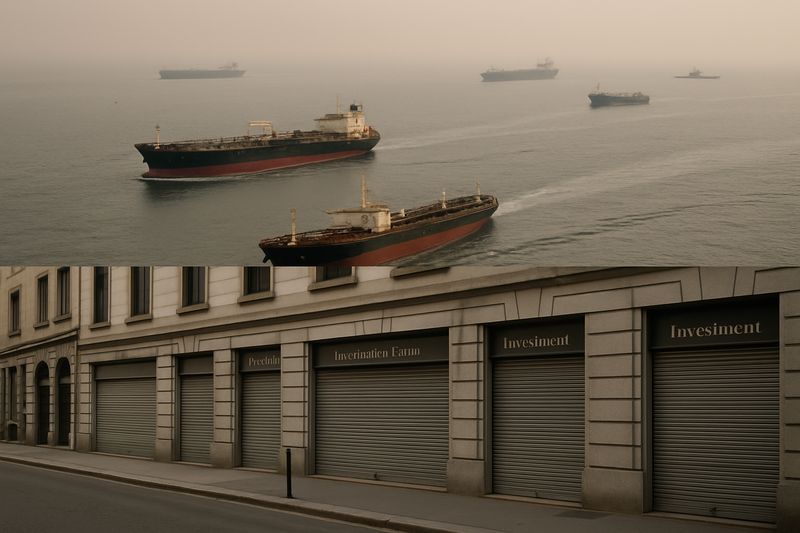
The Hormuz situation is the macro story right now, full stop. Bank of America's Francisco Blanch dropped a stat on CNBC that deserves a second read: the Strait needs 80 to 100 ships per day to stabilize energy markets before winter. Current traffic? 5 to 10 ships. Supertanker costs on the Middle East-to-China route are approaching $500,000 per day. Iran is tying reopening to US concessions it knows Washington won't give, and Trump has shifted from threatening total obliteration to, in his words, 'low-keying it,' which is either diplomatic restraint or a very expensive shrug depending on who you ask.
The sector rotation this week tells the whole story. Energy and consumer staples outperformed while tech was the biggest loser. $AAPL fell 1.5% after a Jefferies downgrade, with analyst Edison Lee citing concerns about the 20th anniversary all-glass iPhone potentially being canceled. $INTC announced a $15 billion stock offering to fund AI capital expansion, choosing equity over debt because its near-bottom investment-grade credit rating makes bond financing ugly. The stock absorbed it. Barely. And SpaceX was a rare bright spot, climbing 4.2% to close at $138.74, above its $135 IPO price.
The macro pressure building underneath this surface calm is real. Nominal GDP ran at 7.9% in Q2 using the GDP deflator, per Morgan Stanley's Jim Caron, who expects 10-year yields to trade sideways through year-end in a higher-for-longer regime. Wednesday's CPI print and September's Jackson Hole are now the two events every portfolio manager is circling in red. Services inflation is sticky, energy is rising, and the Fed has about as much room to maneuver as a supertanker in the Strait of Hormuz right now.
JPMorgan raised its S&P 500 price target to 8,000 and Evercore is floating a bull case of 9,000, citing earnings growth running at roughly 20% this season. Goldman's Tony Pasquarello says both fundamentals and technicals support the bull trend. The bull case is real, the bear case is a tanker war and an oil shock headed into winter, and the market is currently betting on the former while quietly paying up for the latter at the pump.
If Wednesday's CPI comes in hot, this polite little selloff gets a lot less polite.