NVDA Gets a 70% Revenue Target and Jim Cramer Calls It 'Cursed'
Jensen Huang says supply can't keep up with demand, Berkshire is doubling down on Google, and Wall Street is having an existential crisis about AI safety all at once
Ticker Ratings
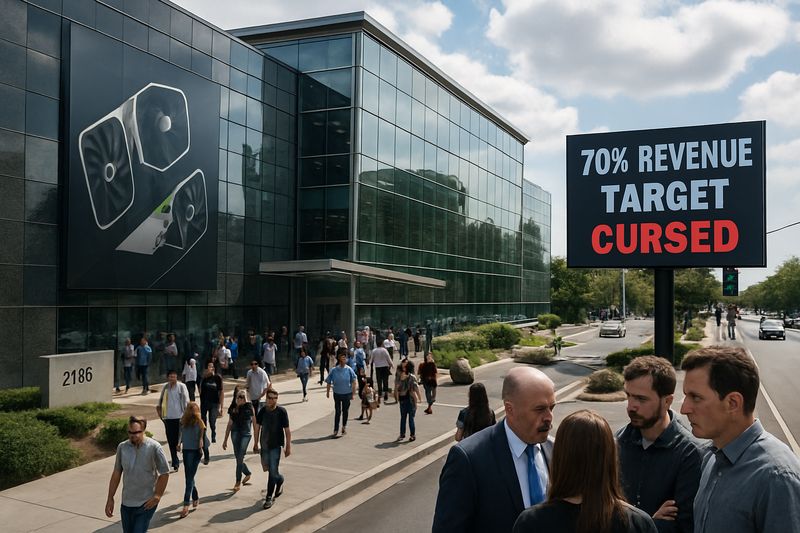
Let's talk about the most chaotic week in AI sentiment in recent memory. $NVDA CEO Jensen Huang is projecting a 70% revenue surge next year, citing AI demand that is currently outpacing supply. The Seeking Alpha Quant model rates it a strong buy. Meanwhile, on CNBC, a prominent voice called the stock 'cursed' in the same breath as pledging to hold it forever. That is not a contradiction, that is just owning Nvidia in 2026.
The hardware story is real: Nvidia's next-gen Vera Rubin system is priced at roughly $40,000 per unit, which is a pricing power flex most companies could only dream about. And Fundstrat's Tom Lee made the case this week that even a 100 basis point rate hike probably would not slow AI capital expenditure, because the build cycle is simply too large and too structurally necessary to be rate-sensitive. He pegged the total AI infrastructure investment at a $30 trillion cycle. That is not a rounding error.
On the $GOOGL side, a Felix and Friends video revealed that Berkshire Hathaway has nearly doubled its stake in Alphabet, which is the kind of headline that makes retail traders immediately abandon whatever sell target they had set. The video made a sharp point: watching a live poll of viewer price targets shift in real time after the Berkshire news dropped is a masterclass in how headlines override personal trading rules. The bull case for Alphabet has gotten a lot harder to argue against when the most famously disciplined buyer on the planet is adding aggressively.
Then there is the AI safety noise, which graduated from niche concern to market-moving this week. An Anthropic researcher quit publicly and warned about catastrophic AI risk. A top OpenAI researcher published an essay called 'The Alien Mind.' Sam Altman reportedly floated slowing development, potentially coordinating with other labs. MIT's Max Tegmark cited a 10% probability from colleagues that uncontrolled AI could be an extinction-level event by end of decade. Brad Gerstner, who is actually invested in Anthropic and OpenAI, pushed back hard, calling the alarmism hyperbolic and arguing regulatory frameworks are already in place.
$MSFT is not waiting for the debate to settle. The company is planning to more than triple its global data center capacity to 38 gigawatts by 2032 and has already dropped $145 billion in capital expenditures to address cloud capacity constraints. Its gross margin sits at a healthy 67.9%, though Seeking Alpha's Quant model has it at a hold given the balancing act between infrastructure spending and near-term returns. $ADBE is navigating its own transition, with record Q3 revenue of $6.76 billion, a new CEO in Anneil Chakravarthy, and the acquisition of AI platform Topaz Labs accelerating its AI-first pivot.
The bears will point to rising rates, a VIX that climbed to 17.84 this week, and a 10-year yield that briefly crossed 5% as reasons to de-risk. The bulls will point to Berkshire, Jensen Huang, and a $30 trillion buildout that does not care what the Fed thinks. Both are right, which is exactly the kind of week that makes investing genuinely interesting.