Diesel Hits $5.89/Gal as Hormuz Stays Shut: Who Wins, Who Bleeds
Brent crude at $97, retail diesel at an all-time high, and bond investors in open revolt. The Strait of Hormuz crisis has a second act.
Ticker Ratings
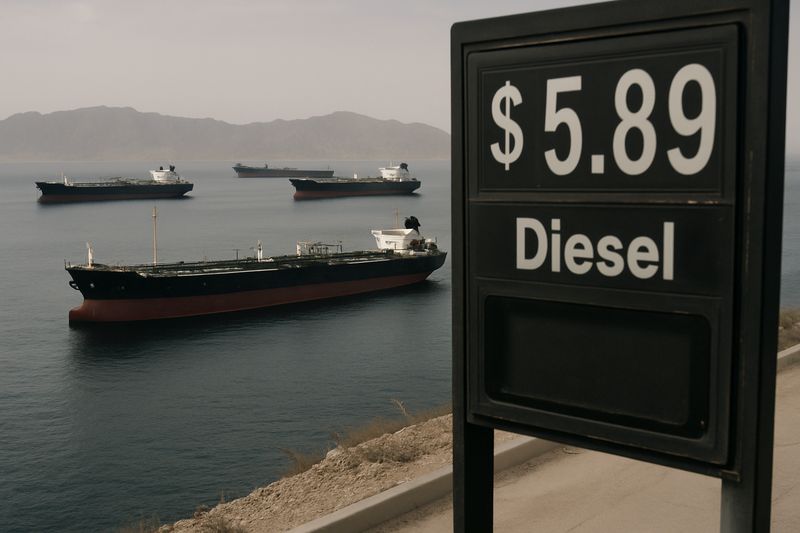
Everyone is talking about oil. Fewer people are talking about diesel. And almost nobody is talking about what $5.89 per gallon retail diesel does to the entire logistics spine of the U.S. economy. That number, cited by Bloomberg News Now, is up from $3.71 just one year ago. A 59% jump in twelve months. Your Amazon packages, your grocery store shelves, your construction sites: all of them run on diesel. This is not a gas pump problem. This is an everything problem.
The trigger is obvious. Iran has formally announced the Strait of Hormuz stays shut until the U.S. meets interim deal conditions. Trump has publicly ruled out near-term talks and floated bombing Oman as a negotiating tactic (sure, that will help). With Brent crude already at $97 per barrel and Iran threatening to announce a new restricted zone in the Gulf in the coming days, the ceiling on oil prices is not a ceiling at all right now. It is more of a suggestion.
The social sentiment picture across YouTube and X is split into two camps. The macro-doom crowd, led by channels like Jeremiah Babe, is fixating on the Fed angle: a potential 25 basis point rate hike on September 16th layered on top of an energy shock is a particularly nasty cocktail. Rising 10-year Treasury yields are the canary, and a break above 5% is the number traders are watching like hawks. Meanwhile, the Bloomberg camp is flagging copper, which just hit an all-time high on the London Metal Exchange, as a separate but related signal that commodity markets are broadly repricing geopolitical risk.
So who actually benefits here? Domestic U.S. energy producers with minimal Gulf exposure get an obvious tailwind from sustained high prices. Refiners with locked-in margins on diesel look interesting. Logistics and airline names, on the other hand, are staring at input costs that do not care about their feelings. The UAE has pledged its energy exports will not be held hostage by the conflict, which provides a small offset, but with Iran warning that U.S. energy assets in the Gulf are vulnerable, that pledge is doing a lot of heavy lifting.
Bond investors are not waiting around to find out how this ends. The Reuters morning note flagged an open revolt in fixed income as Iran threatened to go fully offensive. When bond vigilantes and oil traders are both running for the exits at the same time, the Fed's symbolic 25 basis point move starts to look less like monetary policy and more like bringing a spatula to a flamethrower fight.
Diesel at $5.89 is not just an energy story. It is the inflation story, the election story, and the recession risk story all wearing the same flannel shirt.