Data Centers Under Fire: What Democrat Governors Mean for AI Infrastructure
Democratic gubernatorial wins in the two biggest data center states have investors rethinking the AI infrastructure buildout thesis
Ticker Ratings
| Ticker | Rating | Entry Price | Current | $ Gain | % Gain |
|---|---|---|---|---|---|
| AMD ADVANCED MICRO DEVICES INC | buy | $513.98 | - | - | - |
| SMCI Super Micro Computer, Inc. | hold | $34.05 | - | - | - |
| FSLR FIRST SOLAR, INC. | hold | $201.50 | - | - | - |
| DUK Duke Energy CORP | hold | $126.21 | - | - | - |
| EQIX EQUINIX INC | hold | $1012.18 | - | - | - |
| DLR DIGITAL REALTY TRUST, INC. | hold | $181.99 | - | - | - |
| ANET Arista Networks, Inc. | buy | $189.00 | - | - | - |
| BKNG Booking Holdings Inc. | hold | $155.50 | - | - | - |
| AMGN AMGEN INC | hold | $463.98 | - | - | - |
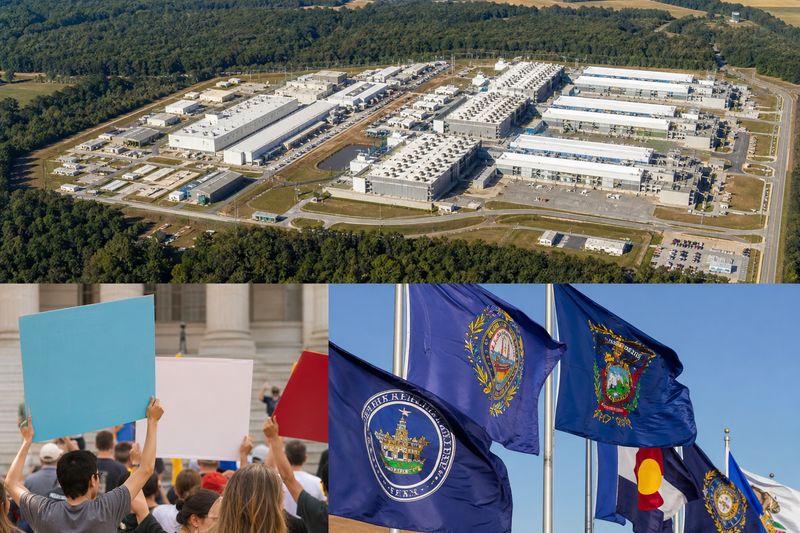
Forget the Senate drama for a second. The midterm result that should have every AI infrastructure investor stress-eating is this: Democrats just won the governor's mansions in Texas and Georgia, the two states that together host a disproportionate chunk of America's data center capacity. Both winning candidates ran, explicitly, on slowing or regulating data center expansion. The market noticed immediately: Nasdaq 100 futures dropped roughly 2% on election night before partially recovering to around half a percent down by morning.
Multiple Bloomberg Podcasts covered the same thread: analyst Ron Brownstein tied the Democratic wave primarily to Trump's 62% national disapproval rating, with 84% of disapprovers voting Democrat. That's the macro story. But the micro story, the one with actual portfolio implications, is what happens to the data center construction pipeline when the two governors most responsible for enabling it are replaced by people who campaigned on hitting the brakes.
The ripple effects are real and immediate. Bloomberg coverage noted that incumbent Senator Lindsey Graham of South Carolina, a reliable ally of the AI and data center industry, lost to Democratic challenger Annie Andrews after the industry spent $4.1 million supporting him. In Ohio, Senator-elect Sherrod Brown explicitly named data centers as a problem in his victory speech, pledging opposition to utility companies subsidizing their power demands. Barry Sternlicht, CEO of Starwood Capital, flagged on CNBC that data center moratoriums spreading across the country represent genuine credit market risk, not just regulatory noise. Meanwhile, 41 ballot measures related to data centers were voted on across 10 states this cycle.
The bull case for data center infrastructure still has legs, sort of. Morgan Stanley CEO Ted Pick, speaking at a Bloomberg event, called AI capex spend of $10 to $15 trillion over the next decade incontrovertible. AMD posted a blowout Q4 forecast of $17 billion in revenue, beating the $16.3 billion estimate, and shares jumped 7.5% after hours on surging data center chip demand. Hyperscalers are still spending. The demand side isn't broken.
But demand means nothing if you can't build the boxes to run it. Jim Cramer flagged on Mad Money that tech leadership is already rotating away from mega-cap AI names toward second-tier plays like AMD and Arista Networks, partly because the mega-cap story is getting complicated by exactly this kind of regulatory and political headwind. The Compass Data Centers CEO told CNBC that the industry has a quality problem, that not all operators are Ritz Carlton, some are Red Roof Inn, and that raising the bar is overdue. That's a polite way of saying: the easy era of building first and asking questions never is over.
The data center trade was always priced for a world where the electricity flows freely, the permits come fast, and the governors stay friendly. Two of those governors just left the building.