Black Friday 2026: AI Shopping, Record Debt, and a Brick-and-Mortar Comeback
Social sentiment lit up around consumer spending this week, and the data tells a surprisingly complicated story about where the American shopper actually stands
Ticker Ratings
If you spent Wednesday doom-scrolling VIX charts and reading about Nvidia chips in Chinese data centers, you might have missed the other big story of the week: American consumers absolutely did not get the memo about an economic slowdown. Social sentiment around retail and consumer spending was one of the loudest chatter categories on YouTube this week, and the numbers behind it are genuinely wild.
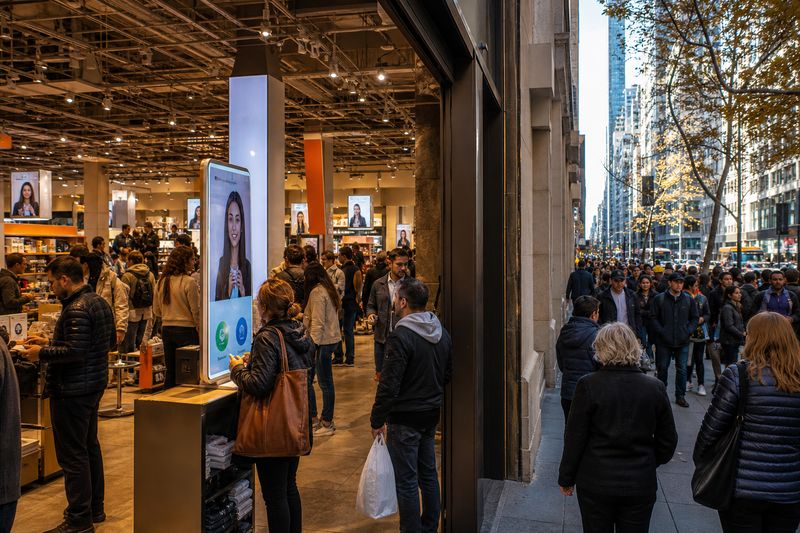
Shopify president Harley Finkelstein told CNBC that Black Friday 2026 hit 27,000 orders per minute and $2.3 million in sales per minute, with average cart sizes ticking up year-over-year to around $115. The National Retail Federation is projecting 183 million consumers shopping over the holiday weekend, with 4% growth and a very strong season overall. Retail analyst Dana Telsey bumped her holiday sales forecast to 5 to 5.5% growth, and in-store foot traffic at Macy's is reportedly on track to surpass pre-COVID 2019 levels for the first time. Physical retail is back, apparently, and it brought friends.
The AI shopping angle is where sentiment really got loud. The NRF says roughly 60% of shoppers plan to use AI in some form during their holiday journey, calling it the beginning of a quote unquote step change. Bloomberg Intelligence highlighted AI agents potentially orchestrating up to $1 trillion in commerce in coming years, with tools like ChatGPT and Google Gemini enabling visual search, price comparison, and deal optimization at scale. For $AMZN and $GOOGL, that is either a massive tailwind or a slow-motion threat to their search dominance, depending on who controls the agent layer. Watch that space closely.
Here is the uncomfortable wrinkle in the holiday cheer: US credit card debt just hit a record $1.29 trillion, up more than 4% year-over-year per the New York Fed, per CNBC's coverage. Consumers are spending, but they are increasingly doing it on borrowed money with PCE inflation running at 3.8% in October. That is not a consumer cliff, but it is absolutely a consumer tightrope. The holiday season accounts for roughly 20% of annual retailer revenue, so the stakes for missing here are enormous.
For $SHOP, this week was basically a live commercial. For department store stalwarts like $M (Macy's), the brick-and-mortar comeback narrative is real and underappreciated by a market that wrote physical retail off two years ago. The bear case is simple: if that credit card debt binge hits a wall in Q1 2027, the holiday sugar rush becomes a January hangover nobody wants to talk about right now.
Sixty percent of your shoppers are already using AI, and you still think the checkout experience is your competitive moat. Bold strategy.