Apple Missed Services, Lost China, and Still Fell 9%: Now What?
The Magnificent 7 split in two this week, and the fault lines are exactly where you'd expect them
Ticker Ratings
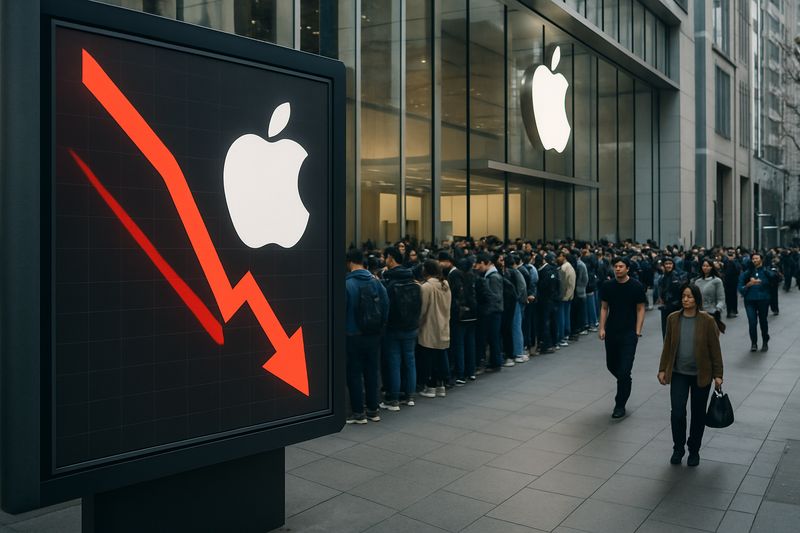
This week the Magnificent 7 officially became two separate teams, and the scoreboard was brutal. $AMZN had its best weekly gain since 2015, up 17%, while $AAPL tumbled nearly 9.5% in a single session after admitting it misjudged smartphone demand and ran into component shortages that dinged its forward guidance. One company bet big on AI infrastructure. The other bet on vibes. You know which one won.
Let's do the Apple autopsy fast. Revenue came in at $109.42 billion, technically a beat versus the $108.85 billion estimate. EPS of $2.20 topped forecasts. Great, right? Not quite. Services revenue of $30.74 billion missed the $31.36 billion consensus, and Greater China revenue landed at $18.82 billion versus the $19.58 billion expected. Apple's gross margin of 50.1% included roughly 2 percentage points of benefit from tariff refunds, meaning the underlying margin picture is softer than it looks. Strip that out and the story gets less pretty quickly.
Meanwhile $AMZN was printing money. AWS revenue jumped 37% to $42.2 billion, the fastest growth since Q4 2021 and the fifth straight quarter of acceleration. The company raised its 2026 capex projection to $220 billion, mostly aimed at AI, and Morgan Stanley promptly upgraded the thesis, praising a stronger backlog and surging profitability. Amazon's custom chip strategy, specifically its Trainium silicon, is giving it a cost edge over $MSFT, which itself surged 15% on strong Azure cloud numbers. It was Microsoft's best single-day move since October 2008, which is one of those sentences that makes you stop and reread it.
The broader context here matters. A fund blowup earlier in the week, Leopold Aschenbrenner's Situational Awareness AI hedge fund imploding from $45 billion to $10 billion after 4x leverage forced mass selling, created a temporary liquidation event in AI and memory stocks. TheChartGuys noted on YouTube that liquidations like this historically produce V-shaped bounces and are among the best buying setups. The NASDAQ has six consecutive lower highs on the weekly chart, but a climax bottom may be forming. Semiconductor names like SK Hynix and Samsung surged 25 to 30% as that selling pressure cleared.
The social sentiment split is just as stark as the price action. YouTube channels from Jeremiah Babe to Bloomberg Businessweek are all talking about the same Fed backdrop: Kevin Warsh held rates at 3.5 to 3.75% in a fractured 9-to-3 vote, with three hawks voting to hike. Warsh's press conference was called a twisted tantrum by analysts, credited with steepening the long end of the yield curve. Credit spreads widened at month-end, which a Bloomberg equity strategist flagged as a direct negative for stock valuations. $AAPL is the perfect victim of a rising-rate, rising-yield environment where you need to show AI monetization now, not someday.
Bill Nygren of Harris Associates said on CNBC that current investor behavior feels uncomfortably like the dot-com peak: familiarity with the technology is being confused for actual investing expertise, and there is a widespread lack of fear of risk. He is not wrong, but he would have been saying the same thing about AWS in 2018, and being right too early is just being wrong with extra steps. The real tell for next week is Friday's jobs number: consensus sits at 80,000 to 100,000 payrolls, but Bloomberg Economics has a gloomier 50,000 in mind, citing World Cup hiring pull-forward and AI-driven labor demand reduction. If payrolls print soft and yields drop, the NASDAQ bounce could get interesting fast. If they print hot and Warsh finally blinks hawkish, Apple's bad week might just be the preview.
BullApe's AI grades every pick against the S&P 500 - wins and misses published. See the track record →