The AI Bubble Warning Nobody Wants to Hear in 2026
Social sentiment is flashing mixed signals on AI stocks even as hyperscalers keep spending, and history says that's exactly when you should be nervous
Ticker Ratings
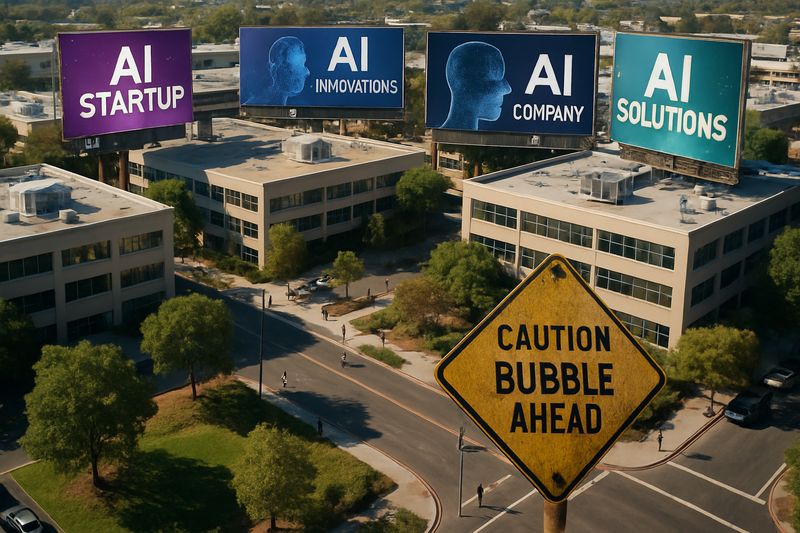
Here is the uncomfortable thing about bubbles: they do not pop when companies stop spending. They pop when investors stop believing. And according to sentiment flooding YouTube's finance community right now, belief in the AI trade is starting to crack at the edges, even as the spending numbers stay enormous.
The comparison getting the most traction comes from a deep-dive by Andrei Jikh, who points out that the Nasdaq peaked in March 2000, while fiber optic infrastructure spending kept accelerating well into 2001, a full year after the market had already collapsed. The companies were still writing the checks. The market had already decided it did not care. If hyperscalers like Microsoft, Google, and Amazon keep pouring money into data centers, that does not mean $NVDA and the AI supply chain are safe. The market reprices on sentiment, not invoices.
The bear case getting louder from credit market watchers is that spreads are not the reliable early-warning system people assume. As one Bloomberg analyst framed it, credit markets were catastrophically wrong in 2007, and there is a real argument they are underpricing AI-related risk again now. The thesis: one major hyperscaler pulling back on capex could trigger a cascade. Followers of the AI trade describe it charitably as a momentum-driven cohort play, less charitably as a herd stampede with expensive tickets.
The bull case, to be fair, is not nothing. $NVDA just posted its second highest weekly close ever according to TheChartGuys, and sentiment on social platforms is tracking bullish structure across XLF, XLV, and Utilities hitting all-time highs. Semiconductors are bouncing on a weekly basis and memory stocks, specifically $MU, are the key laggard to watch. If DRAM catches a weekly bid, the thesis for another leg higher in the semiconductor index has legs.
But the macro backdrop is doing nobody any favors. The July jobs report showed a loss of 23,000 jobs with a combined 103,000 downward revision to prior months. Meanwhile geopolitical risk from the Strait of Hormuz situation is repricing oil and risk sentiment simultaneously. Weak labor data plus an energy shock is not the cocktail growth-stock bulls ordered.
The honest read: AI spending is real, the infrastructure buildout is real, but the market has a long history of being correct about direction and brutally wrong about timing. The dot-com fiber companies were not frauds. They were just priced for a world that arrived ten years late.
Watch the hyperscalers, not the semiconductors. The first capex guidance cut is the shot across the bow.
BullApe's AI grades every pick against the S&P 500 - wins and misses published. See the track record →