30-Year Treasury Hits 5.32%: The Chart That's Spooking Every Bull
Rising long-end yields, fiscal panic, and a Fed that can't read its own signals are colliding in real time
Ticker Ratings
| Ticker | Rating | Entry Price | Current | $ Gain | % Gain |
|---|---|---|---|---|---|
| SPY SPDR S&P 500 ETF TRUST | hold | $767.15 | - | - | - |
| JPM JPMORGAN CHASE & CO | buy | $357.00 | - | - | - |
| PG PROCTER & GAMBLE Co | buy | $146.40 | - | - | - |
| KO COCA COLA CO | buy | $91.78 | - | - | - |
| UNH UNITEDHEALTH GROUP INC | hold | $399.99 | - | - | - |
| AMZN AMAZON COM INC | hold | $263.80 | - | - | - |
| GOOGL Alphabet Inc. | hold | $349.39 | - | - | - |
| MSFT MICROSOFT CORP | hold | $486.56 | - | - | - |
| META Meta Platforms, Inc. | hold | $565.52 | - | - | - |
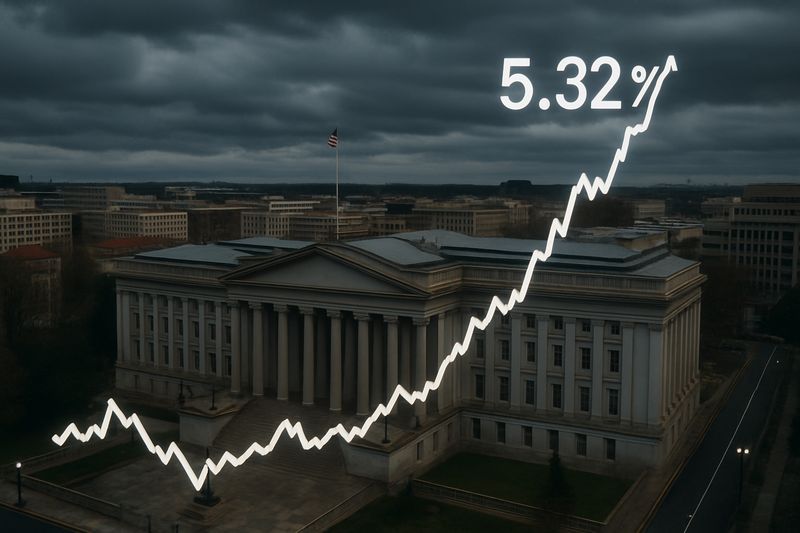
The bond market is done being polite. The 30-year Treasury yield briefly hit 5.32%, a level not seen since before the financial crisis, and the 10-year is parked at 4.7%. According to CNBC's Mad Money coverage from August 24th, this isn't just a number on a screen. It's the kind of rate environment that compresses equity multiples, tightens financial conditions, and turns 'buy the dip' into 'why did I buy the dip.'
Here's what makes this cycle different from your standard yield-rise anxiety: the causes are layered. Morningstar notes there are two very different reasons rates can rise. If yields climb because the economy is growing and credit demand is healthy, earnings growth can absorb the shock. But if yields rise because of inflation fears or fiscal credibility concerns, that's the bad version, and that's the version markets appear to be pricing right now. Apollo's chief economist Torsten Slok told Bloomberg that the Treasury's interventions, using yen buys, FEMA fund expansion, and potentially the $900 billion-plus Treasury General Account, are 'spotty' at best. Fundamental forces, specifically above-target inflation and a 5 to 6% GDP budget deficit, keep pushing rates higher regardless.
The Fed's problem? It can barely see straight. Man Group's Kristina Hooper flagged on CNBC that Treasury market interventions are actively distorting the signals the Fed relies on to set policy. Kevin Warsh's Jackson Hole speech is expected to be big on vision and short on specifics, because internal Fed committees aren't ready with final recommendations. The central bank is essentially flying with cloudy instruments while geopolitical turbulence rattles the fuselage.
Evercore ISI's Julian Emanuel put it plainly: the 10-year yield is the most important chart in the world right now. He had a bull case of 9000 for the S&P 500 this year but acknowledged it's not happening. A surge of bond issuance from hyperscalers, global sovereigns, and the US government is expected after Labor Day, which means more supply hitting a market already nervous about demand from foreign investors who are increasingly reluctant to hold US Treasuries.
The rotation trade is already happening. CNBC coverage of Jim Cramer's commentary shows money moving out of data center and chip names into defensives like $PG, $KO, $UNH, and $JPM. When Procter and Gamble starts looking exciting, the bond market has genuinely changed the game.
The last time yields were here, iPhones were new and people thought MySpace had a future. The bond market remembers even when equity traders don't.